Past Conferences

Scroll down

Hamburg Sustainability Conference 2026

The Power of Cooperation: Driving Progress Together

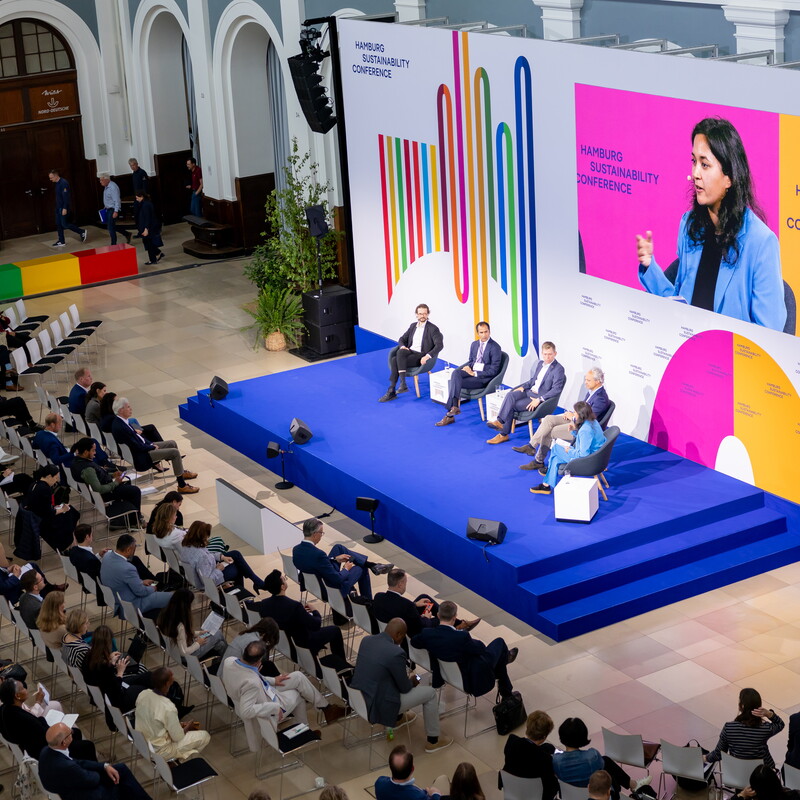
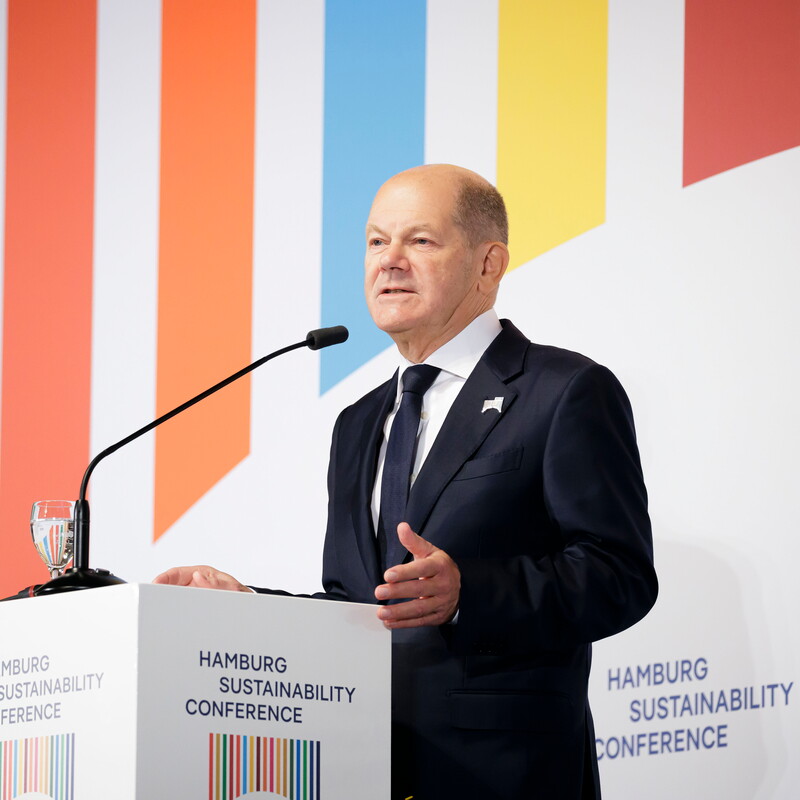
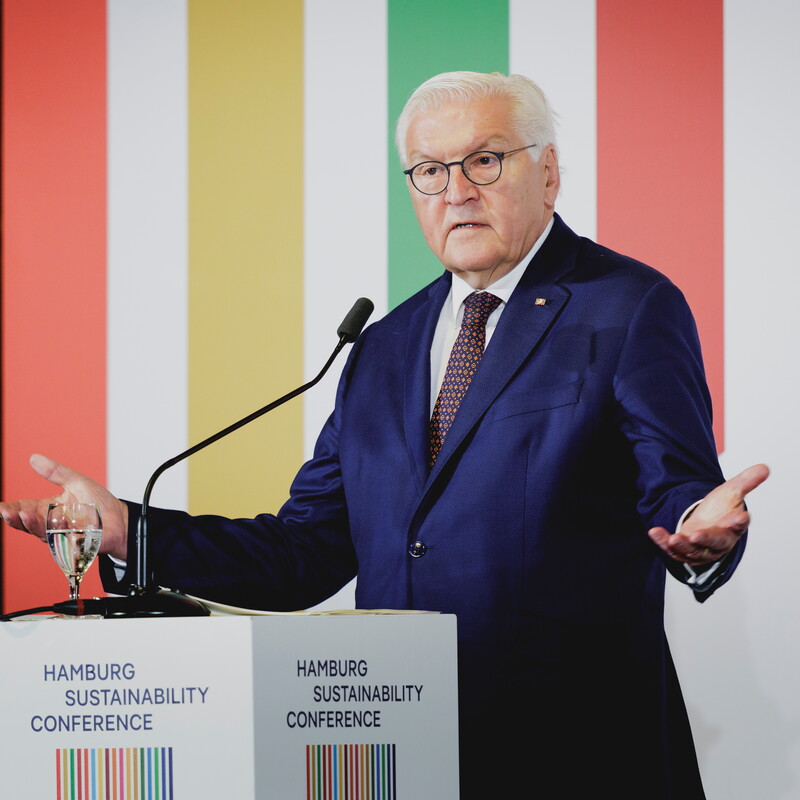
The third Hamburg Sustainability Conference took place from June 29–30, 2026. It brought together leaders from government, business, civil society and academia to turn dialogue into concrete action for sustainable development. In a period marked by geopolitical fragmentation and growing pressure on international cooperation, the conference focused on building new alliances, mobilizing investment and advancing scalable solutions for the SDGs.

Across its three thematic pillars, HSC 2026 explored resilient economies and technology, global risks and conflict, and the future of multilateralism and governance. The conference delivered tangible outcomes, including the launch of the South-North Commission on Development, new initiatives on child nutrition and sustainable finance, progress on responsible AI, and new cross-sector partnerships designed to translate commitments into implementation.

Explore what happened on the HSC 2026 in the full report, available to download here.


Documents & Resources

Download all key conference documents here. Access the Annotated Agenda, Side Events Timetable and an overview of selected participants.


Visit our Speaker List to explore all speakers.

New Alliances 2026

New alliances formed at HSC 2026 are collected here to document ongoing dialogue and outcomes. The collection will be continuously expanded with new publications and conference materials.

Call to Action on Catalyzing Large-Scale Food Fortification to End Child Malnutrition by 2030
GIIF–DEG Partnership with MSIG to Scale Private-Capital Investments in Emerging Markets

GIIF–DEG partnership with MSIG to scale private-capital investments in emerging markets

Link:

DEG und BMZ bauen GIIF weiter aus

ICAMA

The Innovative Capital Mobilisation in Africa (ICAMA) Initiative aims to mobilise capital for African startups and growth firms.

Document:

ICAMA Initiative

Joint Declaration on Addressing the Fallout from the Hormuz Disruption in the Global South

This declaration brings together international partners to support countries most affected by disruptions to shipping through the Strait of Hormuz. It focuses on keeping food and energy affordable, strengthening local production and helping vulnerable communities become less dependent on fragile global supply chains.

Download Declaration

Joint Declaration of Intent to launch a new skills partnership between Hamburg and St. Kitts and Nevis

Hamburg and St. Kitts and Nevis signed a Joint Declaration of Intent to launch a new skills partnership.

Joint Communiqué on Closing the Global Skills and Labor Gap

BMZ, SAP SE, the World Bank Group, and GIZ signed a Joint Communiqué on closing the global skills and labor Gap.

Memorendum of Understanding between FSDAi, FSD Africa and GIZ to Strengthen Capital Mobilization for Africa’s Real Economy

An MoU was signed as part of the ICAMA initiative between FSDAi, FSD Africa and GIZ.

Launch of the South-North Commission on Development
The Commission was officially launched at the Hamburg Sustainability Conference 2026. It will hold regular meetings and regional consultations over the following two years. The Commission will also take part in major international events, including the Hamburg Sustainability Conference and the UN SDG Summit.
The Commission is expected to present its first interim outcomes in 2027 – in the context of the SDG Summit, also marking the 50th anniversary of the first North-South Commission.
It will present a detailed final report at the end of 2028.
 
Website:
 
Further information:
SCALED

Launched by the BMZ and its partners during the Hamburg Sustainability Conference 2026,
Scaling Capital for Sustainable Development is advancing standardization so that capital can move faster, more efficiently and at greater scale.

Link:

Governments and Global Investors Launch SCALED Development

The Alliance Around the Hamburg Declaration on Responsible AI for the SDGs

The initiative was Launched by the BMZ and UNDP during the Hamburg Sustainability Conference 2025.

Document:

One Year of the Hamburg Declaration on Responsible AI for the Sustainable Development Goals

The Global Alliance Against Inequality Welcomed New Members and Agreed on a Joint Statement
Launched at the Hamburg Sustainability Conference in June 2025, the Global Alliance Against Inequality has grown into a coalition of 15 members, bringing together seven governments and eight partner organizations committed to keeping the reduction of inequality high on the international agenda.
 
In the year ahead, the Alliance will work to raise the visibility of the inequality agenda across key global gatherings and to ensure a strong collective presence at the 2027 SDG Summit, while widening its membership and deepening its collaboration with UN entities, regional bodies, and civil society.


Contact Person

Fernando Marani

Document

https://www.sdg16.plus/global-alliance-against-inequality/

UNDP’s Launch of the First Climate Insurance Product in Latin America and the Caribbean Integrated into National Social Protection Systems

UNDP’s launched the First Climate Insurance Product in Latin America and the Caribbean.

Link:

Dominican Republic contracts first parametric insurance as part of its adaptive social protection system

UN Reform International Alliance of 22 Member States

Launched by the BMZ and its partners during the Hamburg Sustainability Conference 2026

Download Statement

Main Themes of the Hamburg Sustainability Conference 2026

Resilient Economies, Technology and the Future of Our Planet

Resilient economies in 2026 are built through systemic transformation across finance, infrastructure, technology, and environmental stewardship. This transformation must engage both private and public actors. Around the world, countries are navigating the “triple squeeze” of tightening fiscal space, shrinking industrial pathways, and intensifying trade and supply-chain pressures. At the same time, climate change and biodiversity loss have become defining economic forces, reshaping agriculture, water security, urban development, and long-term competitiveness.

This thematic pillar brings together sessions that explore how sustainable prosperity can be rebuilt under these conditions—by aligning economic models with planetary boundaries and accelerating transitions in energy, industry, cities, and nature protection. These transitions hold significant potential to drive sustainable job creation and foster innovation across sectors, contributing to inclusive growth and long-term competitiveness. At the same time, economic transformation must strengthen social cohesion, reduce poverty and inequality, and expand people’s capabilities to participate in and benefit from sustainable development. Resilient economies are sustainable only if they ensure that no one is left behind.

Technology is central to this agenda, with the capacity to drive inclusive and sustainable progress. To harness this potential, it must be guided by principles of responsibility and inclusion and embedded in sound legal and policy frameworks. Sessions will examine how digital innovation can strengthen decision-making, enhance transparency, and support sustainable investment pipelines, while avoiding new forms of exclusion. Nature-based resilience and the economics of ecosystems are also core components of these discussions.

Across these sessions, discussions aim to contribute to practical progress in areas including expanded alliances, common standards for climate- and nature-aligned investment, and investment platforms capable of mobilizing capital at scale in the years ahead.

Risk, Uncertainty and Conflict

The world is currently defined by overlapping shocks: geopolitical instability, protracted crises, climate stress, debt burdens, and technological disruption unfolding simultaneously. These converging transitions expose the fragility of global systems and threaten to reverse development gains. Risk is no longer an exception to manage—it is the baseline condition shaping policy, finance, and cooperation.

This thematic pillar groups sessions that confront fragility head-on: from internal displacement and conflict cascades to the economic foundations of resilience in high-risk settings.

A central challenge concerns how resilience can be financed in a context where uncertainty constrains investment. Risk is increasingly ecological and systemic. Biodiversity loss, water insecurity, and climate-related instability are no longer treated as isolated environmental concerns, but as structural economic and security risks shaping long-term stability and competitiveness.

This pillar frames resilience as a collective capability: anticipating shocks, preventing downward spirals, and building institutions and partnerships that can withstand disruption while unlocking sustainable opportunity.

Ensuring the Future of Human Collaboration: Multilateralism and Governance

In an era of fragmentation and renewed geopolitical polarization, multilateralism remains indispensable — yet increasingly contested. Declining trust, strained institutions, and domestic political pressures are weakening collective problem-solving at a time when shared risks are increasing.

In an increasingly multipolar world, Emerging Markets and Developing Economies (EMDEs) are exercising greater agency and shaping the terms of international cooperation more actively. Cooperation is expected to be grounded in sovereign equality, mutual benefit, and shared responsibility, while upholding a rules-based international order capable of delivering tangible outcomes. Multilateralism must therefore demonstrate its capacity to translate common commitments into effective action in a way that respects diverse national priorities and development pathways.

This pillar convenes sessions that focus on renewing the foundations of international collaboration: reforming global governance, strengthening alliances beyond blocs, and protecting the institutional conditions for sustainable development. Governance is also being reshaped through new partnership models that foster trust and enable renewed and strengthened cooperation.

Youth Ambassadors at the HSC 2026

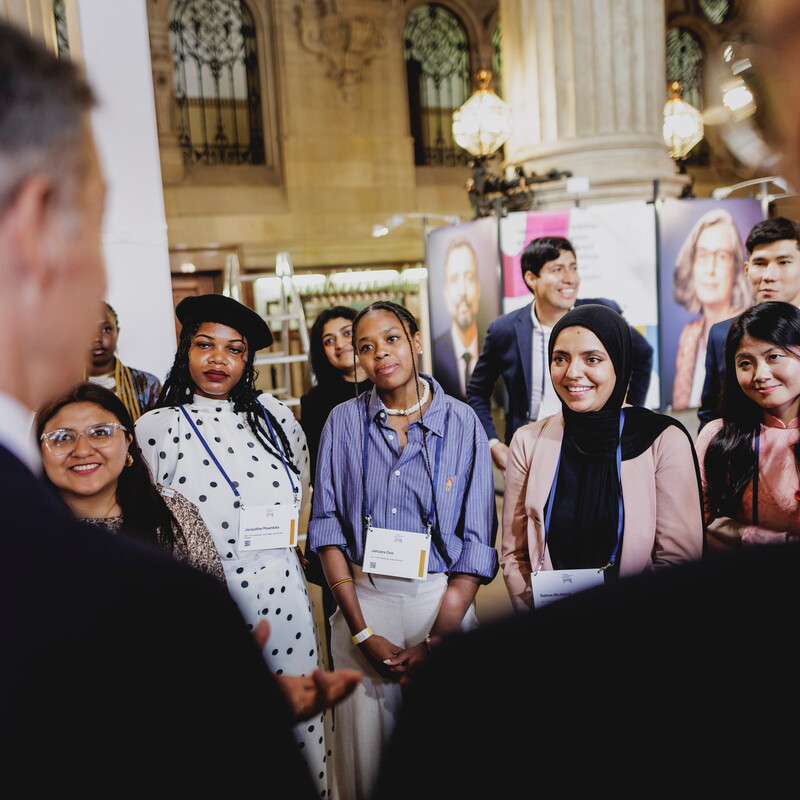
The Hamburg Sustainability Conference Youth Ambassador Program brought together 15 young leaders who join decision-makers, innovators, and changemakers at the conference to drive progress on the Sustainable Development Goals. Through dialogue, collaboration, and fresh perspectives, they shape conversations and solutions for a more sustainable future. Meet the cohort and explore the Youth Ambassador Program.

More Information

HSC Future Economy Day 2026

The Future Economy Day is a dedicated business-to-business conference day held alongside the Hamburg Sustainability Conference on July 1, 2026. Bringing together leaders from finance, industry, manufacturing, and trade, the event focused on practical solutions to accelerate sustainable economic transformation.

It was organized by the Hamburg Chamber of Commerce, ICC Germany, and DZ Bank, with support from UNECE, the Climate Champions, econsense, and Hamburg Sustainability Conference gGmbH.

More Information


Hamburg Sustainability Conference 2025

New Alliances Start Here

Just eight months after the first conference, the second HSC unfolded in a markedly different global context. On June 2–3, 2025, amid profound shifts in international relations, rising geopolitical tensions, and accelerating transitions in the global economy the continuation of HSC came at a pivotal time. To forge new partnerships, advance progress on the SDGs, and reinforce the idea that a sustainable path forward is not only a moral imperative but a strategic path to longterm stability.


Multilateralism is the answer to global challenges

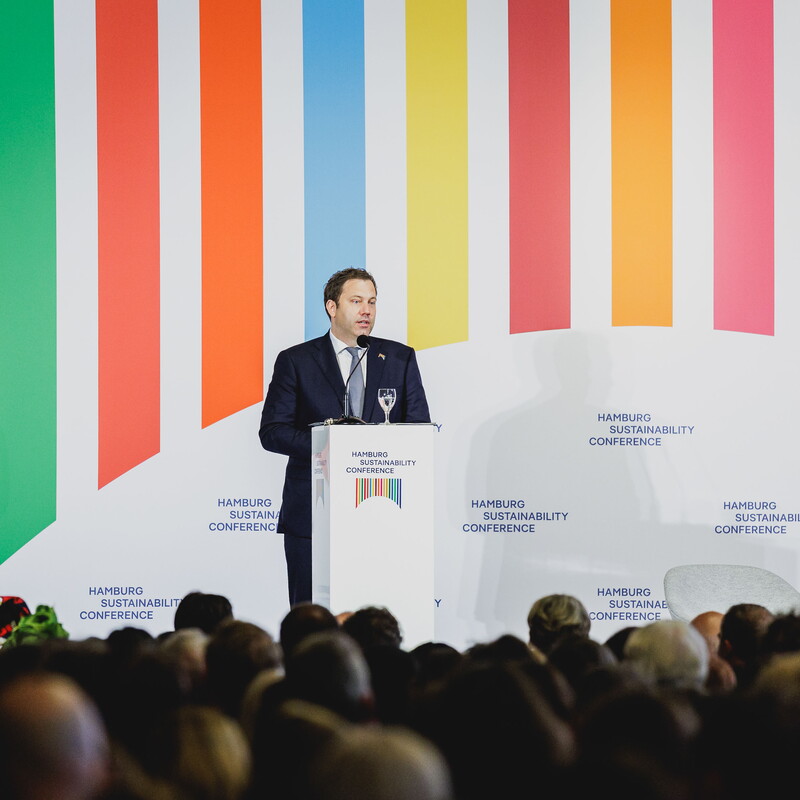
Lars Klingbeil, German Vice-Chancellor and Federal Minister of Finance


New Alliances 2025

Biodiversity Fund, Aid by Trade Foundation (AbTF)
Global Alliance against Inequality
Hamburg Declaration on Responsible AI for the SDGs
Innovative Capital Mobilisation in Africa (ICAMA)
Joint Statement on Strengthening Municipal Access to Private Capital
New Partnership between DEKRA and UNICEF
Scaling Capital for Sustainable Development (SCALED)

Press Release:

Press Release SCALED at HSC 2025


Website:

www.scaledevelopment.org


Contact:

Martin Ewald (Lead Build Phase) and Marc Sindlinger (Secretariat Manager, Build Phase), mobilisation@giz.de

Specialized Arbitration Mechanism for Sustainability-Related Commercial Disputes

HSC Future Economy Day 2025

The Future Economy Day is an additional conference day of the Hamburg Sustainability Conference, that took place on June 4, 2025 at the Handelskammer. Organised by business for business, this event addressed practical challenges in achieving a sustainable economic transformation.

Organised by ICC Germany, DZ Bank, and the Hamburg Chamber of Commerce, with support from UNECE, Climate Champions, econsense and the Hamburg Sustainability Conference gGmbH.

Youth Ambassadors at the HSC

We are committed to foster a transition toward a sustainable future that is shaped collaboratively with those who will be most positively impacted by it.

The Participants of the HSC 2025

The Hamburg Sustainability Conference brought together leading actors from politics, business, science, and civil society to jointly shape actionable pathways toward achieving the UN Sustainable Development Goals (SDGs). Click here to find out who attended the conference in 2025.


Hamburg Sustainability Conference 2024

Transforming Challenges into Alliance Opportunities

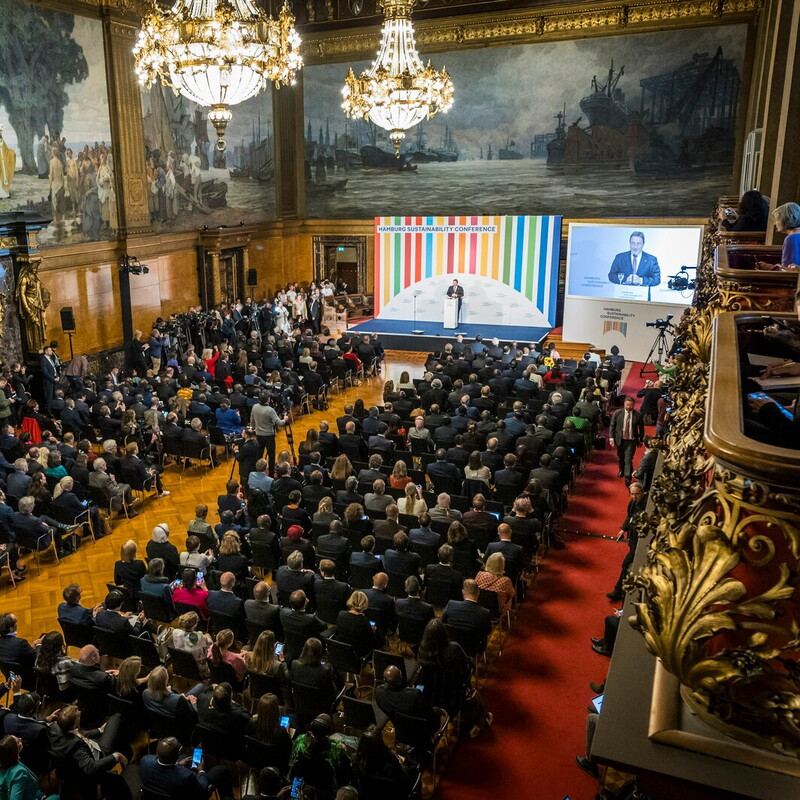
The inaugural first HSC took place on October 7—8, 2024 at the City Hall and the Chamber of Commerce in the Free and Hanseatic City of Hamburg. It brought together global leaders from politics, business, science, and civil society, all united in taking decisive steps toward achieving the UN SDGs. Through vibrant dialogue, trust-building, and solution-oriented collaboration, the HSC focused on addressing some of today’s most pressing global challenges while fostering impactful, long-term partnerships.

Across three key forums, five hubs, and over 60 sessions, participants explored ways to reshape international financial systems, increase investments in sustainable development, and harness innovation for transformative change. Together, they rethought, reorganized, and took concrete actions to create a sustainable future for all.

To strengthen mutual trust of the global community once again and at the same time to show: With strong international partners, global challenges can be mastered, that is the goal of this conference.

Former Federal Chancellor of Germany Olaf Scholz
Hamburg Sustainability Conference 2024

New Alliances 2024

Agreement on shared principles for the development and use of AI in a human-centred way to achieve the SDGs
Alliance in Support of a Global Billionaire Tax
Cameroon Joins Forest Protection Partnership
First governments join the Global Battery Alliance
Germany joins Global Alliance Against Hunger and Poverty
Germany signs hybrid capital agreement with World Bank
Hamburg Charter for Inclusive and Just Mobility
Hamburg Declaration on Green Aviation
Hamburg Declaration on the Decarbonisation of Global Shipping
Hamburg Sustainability Platform (Now: SCALED)

Document:

Hamburg Sustainability Platform (now: SCALED)


Website:

https://scaledevelopment.org


Contact:

Martin Ewald (Lead Build Phase) and Marc Sindlinger (Secretariat Manager, Build Phase): mobilisation@giz.de

International Call for more Co-Determination in the Just Transition
New Co-Financing Agreement between the World Bank and KfW
Ramping up the Green Hydrogen Market: BMZ Supports the Transformation of Egypt’s Ammonia Production via PtX Development Fund
Weltweite Allianz für Landschaftsbasierte Dekarbonisierung (WALD-Initiative)

The Participants of the HSC 2024

The Hamburg Sustainability Conference brought together heads of state and leading actors from politics, business, science, and civil society to jointly shape actionable pathways toward achieving the UN Sustainable Development Goals (SDGs). Click here to find out who attended the conference in 2024.